|
| |
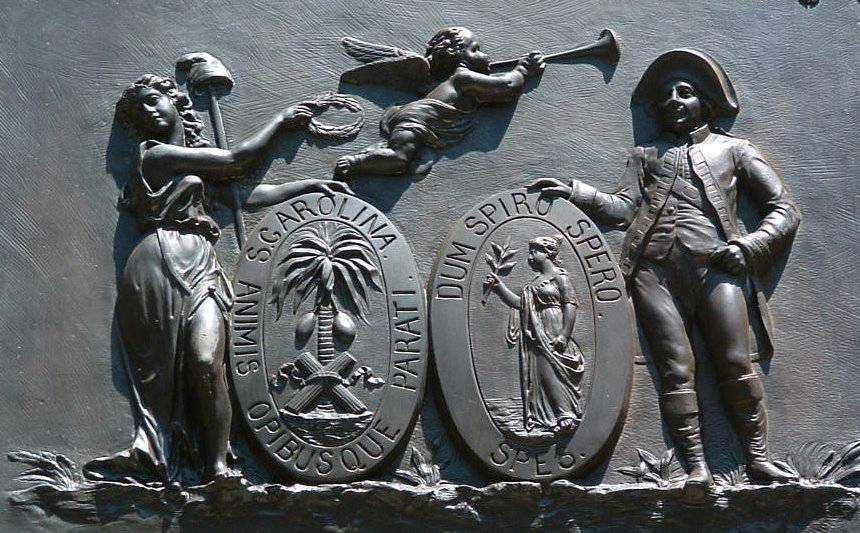
The Washington Light Infantry (WLI), organized in 1807, is one of the nation's oldest
militia units. Anticipating a second war with Britain, the citizens of Charleston planned for a number of volunteer corps, one of which was the Washington Light Infantry. It alone survives.
The Corps was named in honor of George Washington. Annually, on his birthday, February 22, a military
banquet is observed by the Corps. The famous Eutaw Flag (the story of which follows) was borne by
another Washington, Colonel William Washington, a cousin of General George Washington.
Since 1807, the Washington Light Infantry has participated as a unit exhibiting honor and bravery in every major war this country has fought. Beginning in 1812, during the
War of 1812 between the United States and Great Britain, and to 1814, the company was mustered into active service. No military event occurred in this section of the country and the infantry did not serve.
In 1824, the company was distinguished with the "Fusilier
Francaise" or as a special guard of honor. Its function was to escort the Marquis de Lafayette into
Charleston. The Captain gave his commands in French. Having been previously coached in French commands, the company's performance was heralded as a compliment and was received with much delight by the General.
On April 19, 1827, the widow of Colonel William Washington of the Revolution, Jane Elliot Washington of Sandy Hill, South Carolina, assigned her husband's battle flag to the Washington Light Infantry. Today, the flag is still preserved as the Corp's most precious relic.
In 1836, the Washington Light Infantry hastened to the rescue
of the city of Saint Augustine. The rescue afforded the women and children of the city
protection from the torch and tomahawk of the Seminole Indians, who massacred
three hundred U.S. troops in the wilds of Florida.
Additionally, in 1842, the Washington Light Infantry greatly assisted in the
establishment of the South Carolina Military Academy (now known as The Citadel).
In 1843, the WFI relinquished the guard of the Citadel building to the new Cadet
Corps.
When the Mexican war broke out in 1847, the Federal Government called upon the Governor of South Carolina for a regiment of infantry. The Charleston volunteers were accepted and Ensign William Blanding of the Washington Light Infantry was called to its command. As a part of the famous and
historic "Palmetto Regiment", it shared the trials and distinctions of General Scott's brilliant campaigns.
Obeying the authority of the State of South Carolina, when the
War Between the States developed in 1861, the Washington Light Infantry
formed themselves into three companies to remain through the war until 1865. The total number of men enrolled
was four hundred and fourteen. At the close of the struggle, its
casualties numbered one hundred and fourteen killed, and many others maimed
and scarred for life. Official reports show frequent citations of acts of
individual heroism and deeds of sublime courage on the part of the Washington Light Infantry officers and men.
The war over, the
survivors returned to their homes, and in 1866, they formed what was called
the Washington Light Infantry Charitable Association. The organization was the first
organization of its kind in the South created to assist the families of those who
had fallen or who were disabled by the war. Today, this Association is known
as the W.L.I. Charity Fund, and its by-laws have been amended to allow the
destitute families of fallen comrades of all military engagements, wars, and
even riot duty, to benefit.
Many
persons have credited the Washington Light Infantry with using their utmost
influence in 1842 in the founding of the South Carolina Military Academy,
now known as The Citadel, the Military College of SouthCarolina. At the
close of the War Between the States in 1865, the institution was closed and came into
the possession of the Federal Government. The W.L.I was determined that The Citadel
would be reopened for the training and education of South Carolina's sons.
After numerous meetings and by using every influence possible, The Citadel
was finally reopened in the fall of 1882.
In 1916, the Washington
Light Infantry, as Company "B", 2nd. South Carolina Infantry, answered the
call of President Wilson for patrol duty on the Mexican border near El Paso,
Texas. And in 1917, when the United States entered World War I, the active
company of the W.L.I, was augmented to a war strength of 150 men. Under
the command of Captain Harry 0. Withington, the WLI served in the National Army
overseas in the 105th Ammunition Train, 55th Field Artillery Brigade, 30th Division.
Following the war, the National Guard (formerly the State Militia), came
under a vast reorganization plan under the direct authority and supervision
of the Federal Government. The active company of the W.L.I was reorganized
and was mustered into service on June 30, 1919. It became "B" company, 118th
Infantry, South Carolina National Guard, a part of the National Defense
set-up at the call of the President.
In May 1921, the
Washington Light Infantry active company answered the call of the United
States Shipping Board. The WFI began a tour of duty in guarding shipping at docks and at anchor when seamen and shipping interests had a dispute over wages.
In the years following,
the W.L.I. Company "B" was called out several times on tours of duty for
similar crises in the states. In 1940, at the call of the President, the
National Guard of the United States was called to active service for full
time training, where they remained for a year before being sent overseas.
Upon their departure, the reserve company "A" was called to take the place of the active company.
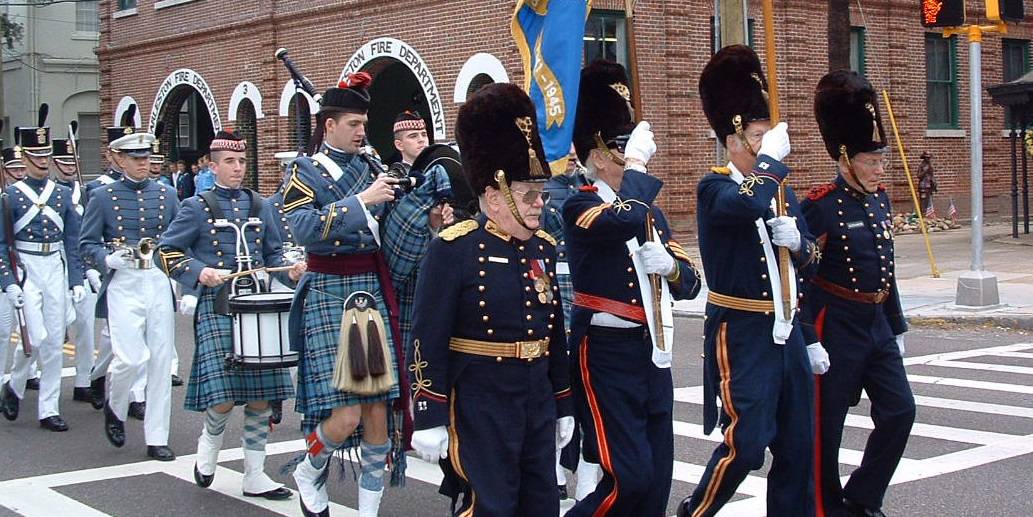
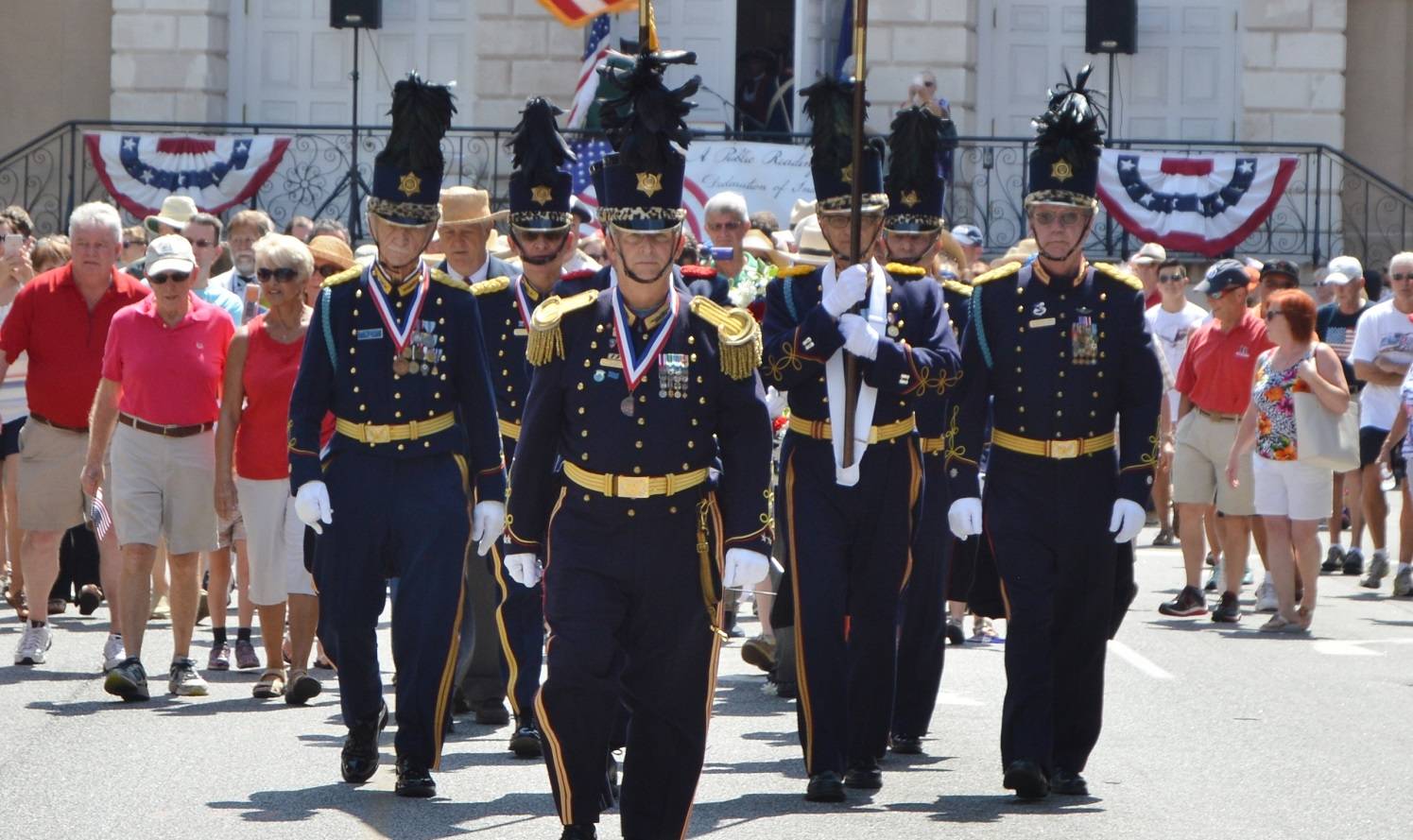
In addition to serving its country in every military engagement, the Washington Light Infantry has had the honor of participating as a military unit in centennial celebrations and ceremonial parades all over the nation. Volunteer Corps are not generally long lived, but this Corps, combining social and military features, has been marked by extraordinary vitality. In addition, the WLI has received an unusual share of popular favor and esteem by the people of Charleston and the nation.
Source: Valor and Virtue: The Washington Light Infantry In Peace and In War. R.L. Schreadley. Spartanburg, SC: The Reprint Company, Publisher. 1997.

The Eutaw Flag
The flag commonly known as the Eutaw flag, now in the possession of the Washington Light Infantry of Charleston, S.C., is a relic of the Revolutionary War.
It formerly belonged to Colonel William Washington, a cousin of General George Washington. John Randolph compared the Colonel, in one of his speeches in Congress, to the "Sword of Marcellus."
The origin of the flag is surrounded by a halo of romance. When on a hasty visit to his fiancee, Miss Jane Elliot, daughter of Colonel Charles Elliot who owned a large estate, "Sandy Hill" near Charleston, Colonel Washington mentioned that he did not have a flag for his troop. Seizing her scissors, she cut from the end of a rich damask curtain a square of crimson silk saying, "Let this be your flag!" To Colonel Washington it was a gift without price. Not only was it to be the flag of his troop, but it was a love token of fealty to her and loyalty to his country. Thereafter, until the close of the war it waved in the forefront of every battle in which his company was engaged.
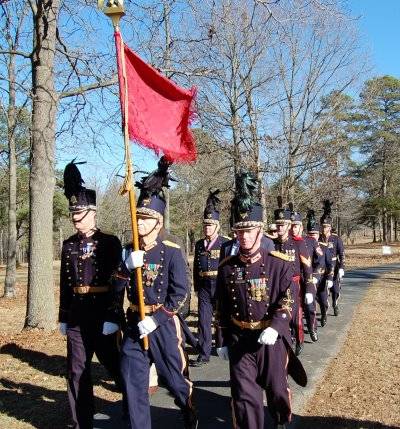
This venerated relic is probably the only one that can be traced back to the battlefields of the American Revolution. The flag is now in the custody of a military corps, still in good condition, and is still carried on parade on special occasions.
Contact Information
- Telephone
- 843-111-1111
-
- Postal address
- 287 Meeting Street, Charleston, S.C.
- Electronic mail
- General Information:
Info@washingtonlightinfantry.org
Webmaster:
webmaster@washingtonlightinfantry.org
|